
How much audio do you need to clone a voice?
Five to fifteen seconds of clean speech. That is the whole answer for any modern voice cloning tool, and if your results are bad, the length of your sample is almost never the reason.
Why it used to be half an hour
Older text to speech worked by training a model on one specific person. You recorded tens of minutes of speech, transcribed it, and spent GPU time fitting a model to that data. The voice lived in the weights, so more data really did mean a better voice.
Few-shot systems changed the shape of the problem. A speaker encoder listens to a short clip and turns it into a compact numeric description of the voice. A general text to speech model then conditions its output on that description. Nothing gets trained per person. The recording stopped being training data and became a reference, and a reference only has to be clear enough to describe.
More audio stops helping quickly
The encoder is summarising, not memorising. Once it has enough to pin down timbre, pitch range and speaking style, extra seconds change very little.
After that, length mostly adds risk. A longer clip is a longer window in which a chair scrapes, someone answers a question off camera, a laptop fan spins up, or you trail off at the end of a thought. All of that gets averaged into the description of your voice.
So if you have five minutes of decent audio, the useful move is not to feed all five minutes in. It is to find the best ten seconds.
What actually decides the result
- One speaker, no overlap. Two voices in the clip give you a blend of two people.
- No music or sound effects under the speech. A music bed becomes part of what the encoder thinks your voice sounds like.
- A dry room. Reverb is baked into the sample and comes back in everything you generate. A bedroom with a rug and curtains beats a kitchen.
- Normal delivery. If you whisper into the mic, the clone whispers. If you read the sample like a hostage note, that flatness carries.
- Full sentences, not a word list. Prosody lives in connected speech.
- Steady distance from the microphone. Moving closer and further changes the tone mid-clip.
- No pre-processing. Noise gates cut consonant tails, and aggressive loudness normalisation pumps the level up and down. Both confuse the encoder more than a bit of quiet room noise would.
Recording ten seconds worth using
Sit in a small furnished room with the windows shut. Hold the phone about a hand span away and slightly off to the side, so your plosives go past the mic rather than into it. Then read two full sentences at the pace you actually talk, something with a range of sounds in it:
We ordered the blue chairs on Thursday and they should arrive before the weekend. Bring the receipt along, just in case.
Listen back on headphones before you use it. You are checking for the room, not for your voice. If you can hear the space you recorded in, move somewhere smaller and do it again.
When the output sounds wrong, look at the sample first
The generation settings are rarely the problem. Most complaints trace back to the reference:
- Thin or metallic output usually means the source was noisy, or already compressed hard by whatever it was recorded through.
- Mumbled output means the sample was mumbled.
- A rushed, clipped read means you rushed the sample.
- A voice that sounds tired was recorded tired.
The clone is faithful. That is the part people underestimate.
Doing it without sending your voice anywhere
Most cloning services want you to upload the recording, which means the one piece of audio you care most about ends up on someone else’s server.
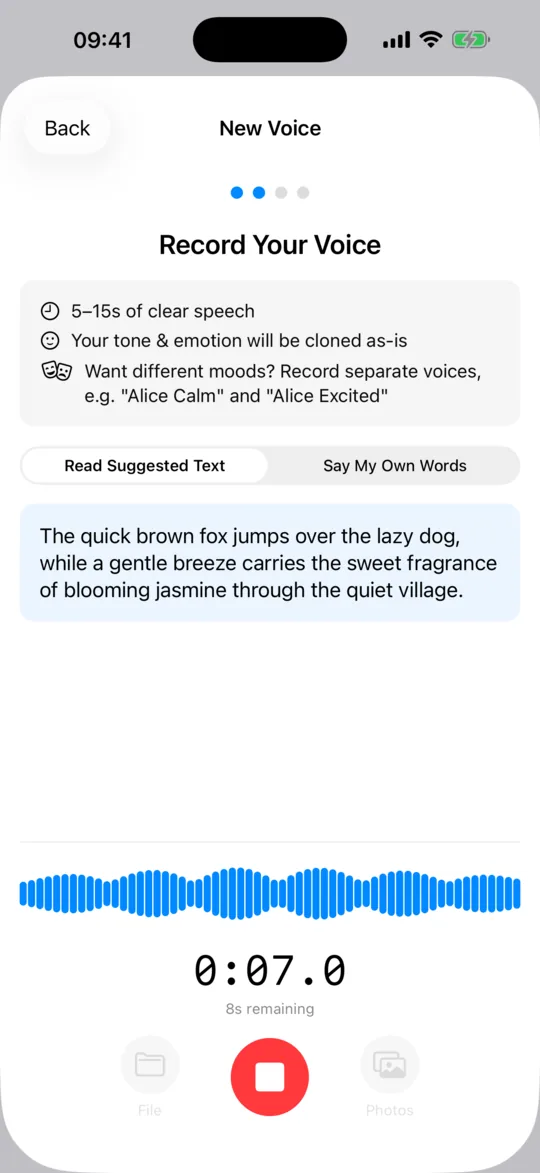
VoiceNPC does the whole thing locally. Record five to fifteen seconds in the app, import an audio file, or drop in a video and let it pull the speech out. The cloning, the translation and the speech generation all run on your device through Qwen3-TTS on Apple’s MLX framework, so nothing is uploaded and no account exists to attach it to. It needs Apple Silicon: an iPhone 13 or later, a recent iPad, or any Apple Silicon Mac.
One thing that is not about audio quality
Clone your own voice, or one whose owner has agreed to it. For anything work related, get that in writing. The technology no longer needs half an hour of someone’s speech to imitate them, which is exactly why the permission matters more than it used to.
Questions
Is five seconds really enough to clone a voice?
For a few-shot model, yes. Five to fifteen seconds of clean, connected speech from one speaker is enough to capture timbre, pitch range and speaking style. The limit on quality is how clean the recording is, not how long it runs.
Does a longer recording ever help?
Only up to a point, and mainly by giving you more good material to choose from. Past roughly half a minute a few-shot model has what it needs, and extra length adds more chances to include a cough, a second voice or background music.
Can I clone a voice from a video?
Yes, if the speech in it is clean. Pick a stretch where the person is talking alone with no music underneath. A clear ten seconds from a video beats a noisy minute.
Does the sample have to be in the language I want to generate?
No. The reference captures how a person sounds, not which language they speak, so a clone made from English speech can read a Japanese or Spanish script. Record in whichever language you speak most naturally.
Do I have to re-record every time I want to use the voice?
No. The clone is saved and reusable, so one good sample serves every script you write afterwards.